
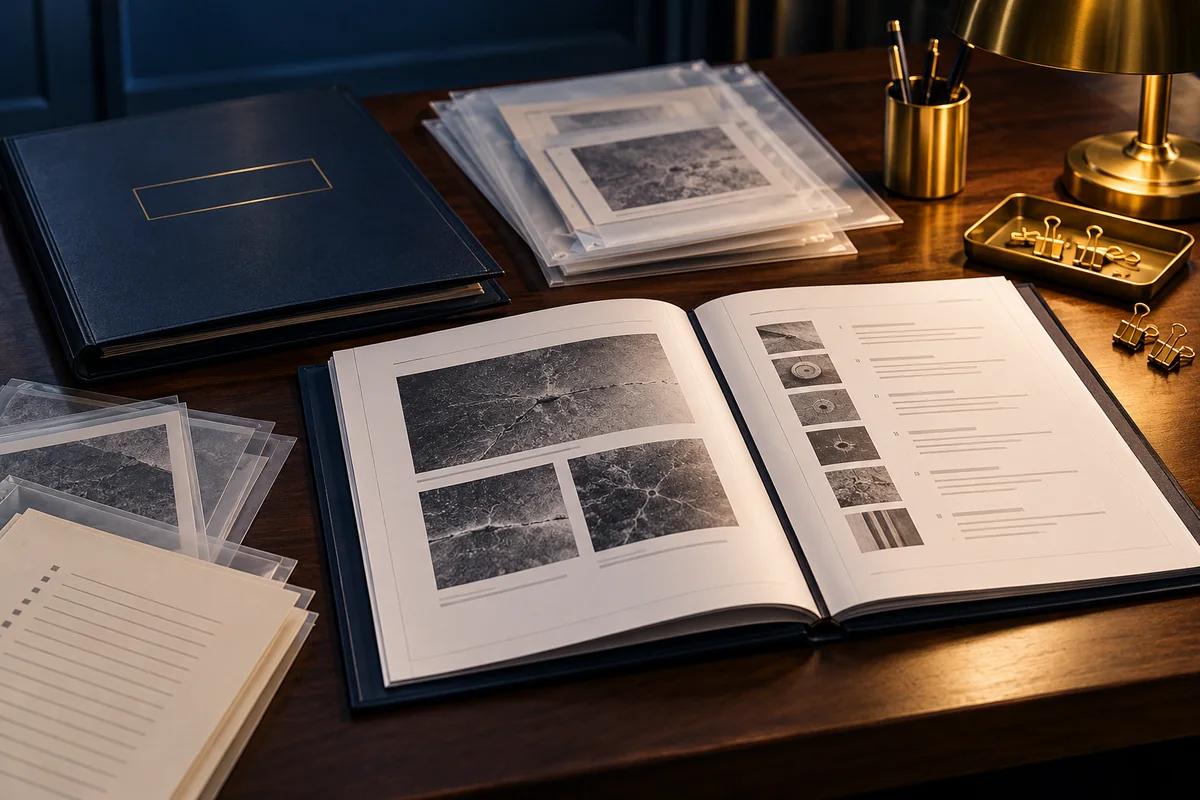
A photographic table is part of a connected document
An appendix cannot be assessed as an independent collection of pictures. Establish which report it accompanies and whether its beginning, end and numbering are retained. Then locate references from the examination section. An image may illustrate an overall view, an individual observation or a comparison; its role depends on how the text uses it.
If an electronic copy contains only selected sheets, identify this. A missing image in your file does not prove it was absent from the complete result. Substantive analysis should ideally include the entire sequence, even pages that seem repetitive: they may explain connections between fragments.
Link the image to a particular object
Check identifiers in the object list, captions and main text. One number may identify a photograph, another an object and a third a figure in a composite table. Do not treat them as identical without explanation. When several images appear together, the reader must understand each one's association. Record a discrepancy with references to both pages without correcting the source copy.
This check helps identify a presentation or material-identification question. A matching caption does not establish that every observation is correct, while a typo does not always change a result. The significance of the issue identified for a particular answer is explained separately.
Distinguish observations from added annotations
Arrows, boxes and comparison lines are added as explanations. They are not object properties. Distinguish the visible detail, the author's annotation and the explanation of its significance. If an annotation covers a relevant area, the question may concern whether this copy permits checking rather than whether the original lacks a feature.
Use a working copy for your own comments. Retain the unaltered file so that the report author's highlights can be distinguished from those added during discussion. Do not enhance an image to the point where original details cannot be distinguished from later processing.
An illustrative example: the text cites an image number absent from the appendix received. The first question concerns the copy's contents and numbering system. Finding the required sheet may resolve the apparent contradiction. If it cannot be found, identify precisely which reasoning step remains unchecked. This differs from asserting that no examination took place at all.
Copy quality limits discernible detail
Compression, scanning quality and page size on screen affect image discernibility. Enlarging a small copy does not recreate lost information. If an important area is unreadable, state that limitation and request an available better-quality file. A specialist feature cannot be judged categorically merely because it is indistinct in a forwarded picture.
Distinguish presentation format from observation content. Check whether image order and captions remain the same across copies of an appendix. If versions differ, identify each source. Visual file similarity alone does not establish their creation history or that a document remained unchanged.
An image does not replace the whole examination
Not every result can be reconstructed fully from one illustration. The expert may have had original objects and other information described in the text or other appendices. The reviewer needs to understand what was checked directly from the document and what is accessible only through the author's description. The Russian Federal Centre of Forensic Science relates ballistics tasks to examination of objects and traces; viewing an appendix is not equivalent to that work.
For a disputed image, find the relevant conclusion and explanation of its significance. Then check what additional grounds are identified. If they are absent from your set, identify a question for clarification rather than fill the unknown with an assumption.
Prepare a focused question list
A useful entry contains the photographic-table page, image number, object identifier and relevant finding. Then describe the problem: an explanation is missing, identifiers differ, an area is unreadable or its connection to the text is unclear. The list helps determine whether a complete file, the author's explanation or substantive analysis by a relevant specialist is needed. Different observations may need different amounts of work.
Avoid the conclusion “the photographic table is poor, so the report is incorrect”. Show which answer cannot be checked and why. Another outcome is possible: comparing the text and appendices resolves the doubt. This matters so that objections address an established problem.
What to send for documentary analysis
Provide the report and photographic tables in full, the original questions and a brief map of disputed passages. If there are several copies, explain their provenance. Do not send firearms, ammunition or other dangerous objects to the website's address. This concerns analysis of existing documents and images without independent testing by the applicant.
You can discuss the set's completeness through report examination. For a reasoned written analysis of the connection between an appendix and findings, agree the subject of the review. The result distinguishes a supported observation, a question for clarification and a limitation caused by the quality or composition of available materials.